
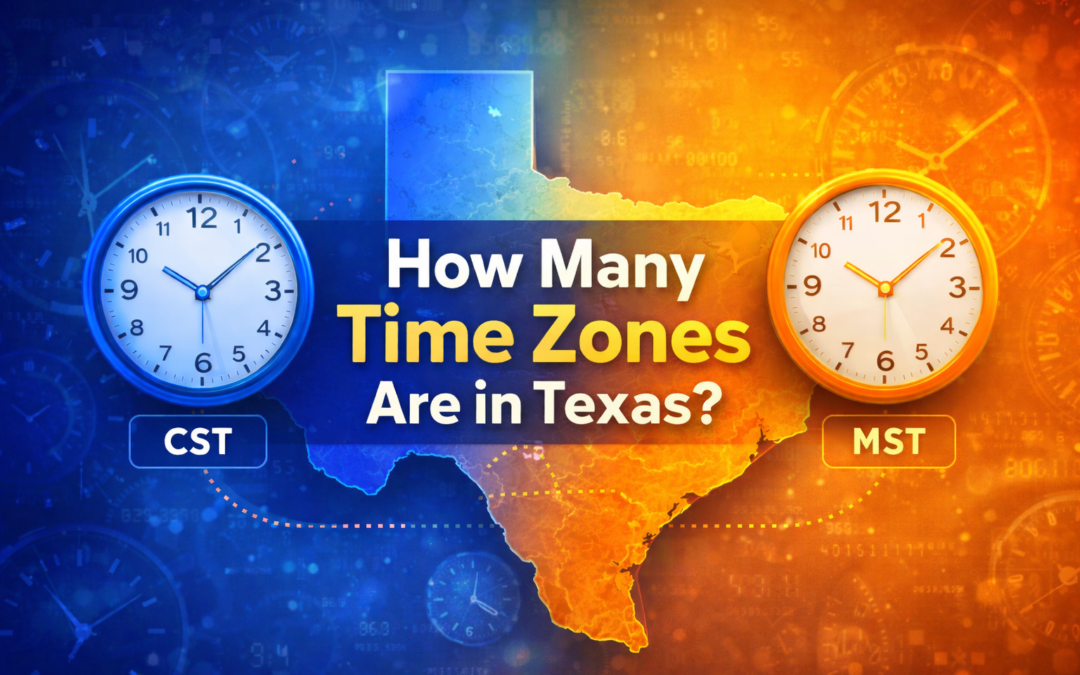
Texas, known for its vast size and diverse geography, spans across two different time zones: Central Time and Mountain Time. Understanding these time zones is essential for both residents and visitors.
This article will guide you through the time zone structure in Texas, how it impacts daily life, and why the state is unique in this regard.
Central Time Zone: The Majority of Texas
Most of Texas, including cities like Houston, Dallas, and Austin, follows Central Time. This means that during standard time, the state observes Central Standard Time (CST), which is UTC-6. During Daylight Saving Time (DST), Texas switches to Central Daylight Time (CDT), adjusting the clock forward by one hour.
The Central Time Zone aligns Texas with much of the central U.S., ensuring that business and commerce with states like Missouri and Louisiana are synchronized. For those traveling across Texas, this means a consistent time schedule for the majority of the state. In fact, most of Texas’ population lives in this time zone, making it the predominant zone.
In contrast, some regions in Texas—like El Paso—observe a different time zone. To understand how this time zone distinction impacts scheduling and daily activities, it is useful to refer to resources like Why Were Time Zones Created?, which explains the history and necessity of time zone divisions across regions.
Mountain Time Zone: A Small Area in Texas
While the majority of Texas follows Central Time, a small portion of the state, including El Paso and parts of Hudspeth County, operates in Mountain Time. This includes both Mountain Standard Time (MST) and Mountain Daylight Time (MDT). The time zone difference may not be immediately obvious for visitors, especially those traveling from major cities like San Antonio.
The inclusion of Mountain Time in Texas is a result of historical decisions made during the state’s development. During the expansion of railroads and trade, El Paso and its neighboring areas were aligned with other Mountain Time regions. As a result, even today, El Paso remains distinct from other Texas cities due to this time zone division.
If you’re curious about how time zone creation helped streamline national commerce and travel, tips such as why they change time offers an in-depth explanation on the subject, shedding light on the evolving need for standardization.
The Impact of Two Time Zones on Texas Residents
Living in a state that spans two time zones can cause confusion for residents. For example, someone traveling from Houston to El Paso will need to adjust their watch by an hour. For residents of El Paso, scheduling meetings or planning events can be more complex as they need to account for the time difference when dealing with those in Central Time.
This time zone division is not just a geographical issue but also impacts business operations. Companies that operate across both time zones, such as in West Texas, must consider the one-hour difference when scheduling meetings, sending communications, or coordinating logistics. It’s important for businesses to take this into account to maintain smooth operations across the state.
If you’re interested in how businesses manage time zone complexities, particularly those involving time-sensitive communication, you can explore the American Time Watch tool to assist with tracking and managing time more efficiently.
Why Texas Has Two Time Zones
The reason Texas spans two time zones stems from the state’s vast size and its history. When time zones were introduced in the late 19th century, they were designed to standardize time for railroad travel. Texas was split into two zones to improve coordination between its vast regions, helping railroads and businesses function efficiently.
Although modern technology has made this division less of a logistical challenge, the time zone difference still holds significance for travelers and businesses. The time zone split also reflects Texas’ historical ties to other parts of the country, such as its trade connections with Mountain Time states. Understanding why Texas follows this structure provides insight into how time zones can shape daily life and economic practices.
FAQ’s
How many time zones does Texas have?
Texas spans two time zones: Central Time (CST) and Mountain Time (MST). The majority of the state, including cities like Houston and Dallas, follows Central Time, while a small portion, like El Paso, observes Mountain Time.
Why does Texas have two time zones?
Texas has two time zones due to its vast size. Historically, the state was divided between Central and Mountain Time to facilitate railroad coordination and trade. The division persists today for practical and economic reasons.
Which cities in Texas follow Mountain Time?
Cities like El Paso, Hudspeth County, and parts of Culberson County are in the Mountain Time Zone. These areas observe Mountain Standard Time (MST) during the winter and Mountain Daylight Time (MDT) during Daylight Saving Time.
Does Texas observe Daylight Saving Time?
Yes, Texas observes Daylight Saving Time (DST). Most of the state shifts to Central Daylight Time (CDT), except for areas in Mountain Time where Mountain Daylight Time (MDT) is used. Clocks are adjusted forward in the summer and back in the fall.
How do time zones affect businesses in Texas?
Time zones can cause scheduling issues for businesses operating across Texas. Companies that span both Central and Mountain Time must account for the one-hour difference when organizing meetings, customer service hours, and logistical planning.
How does the time zone difference impact travelers in Texas?
Travelers to Texas may experience confusion when crossing time zones. For example, traveling from Dallas to El Paso requires adjusting the clock by an hour, which can affect flight schedules, meeting times, and other time-sensitive activities.
Which time zone is most of Texas in?
The majority of Texas follows Central Time (CST). This time zone includes major cities like Houston, Austin, and San Antonio. It is the dominant time zone in Texas, affecting most residents and businesses across the state.
How does the time zone difference affect Texas residents?
The time zone difference can affect residents’ daily lives, especially in areas like El Paso, where residents must adjust to Mountain Time when traveling or coordinating activities with others in Central Time regions, adding an extra step in scheduling.
Is there any historical reason for Texas’ time zone split?
Yes, the division of time zones in Texas dates back to the late 19th century. The state was split to accommodate the growing railroad industry, with El Paso and neighboring areas falling under Mountain Time for logistical coordination with nearby states.
What is the time zone in El Paso, Texas?
El Paso, Texas, follows Mountain Time (MST) during the winter and Mountain Daylight Time (MDT) during the summer, in contrast to most of Texas, which is in Central Time. This difference is due to historical reasons related to trade and travel.
Are there any parts of Texas that don’t observe DST?
Yes, the Navajo Nation in northeastern Arizona, which spans parts of Culberson County, does not observe Daylight Saving Time, while the rest of Texas does. This makes it unique compared to the standard DST schedule observed in the majority of the state.
How does Texas’ time zone division affect education?
In Texas, educational institutions in El Paso need to coordinate with schools and universities in Dallas and Austin, which are in different time zones. This can create scheduling challenges for virtual classes, exams, and event planning across the state.
Does the time zone difference in Texas impact state-wide events?
Yes, state-wide events such as sports competitions and festivals may experience coordination issues due to Texas’ two time zones. For instance, Houston and El Paso might have different schedules, so event organizers need to adjust timings accordingly for both time zones.
How does Texas’ time zone split affect tourism?
Tourists traveling from Houston to El Paso or other cities in different time zones must account for the one-hour difference. This can lead to confusion when planning activities, transportation, or meetings, so it’s important for visitors to check time zone schedules in advance.
Can the time zone division in Texas change in the future?
While it’s unlikely that Texas’ time zone division will change anytime soon, modern technology and digital tools have minimized the impact of the one-hour difference. Time zone divisions are deeply embedded in Texas’ history, so any change would require significant logistical shifts.